Skip to content
🔬 Research

Publications & patents

My research spans sensor-fusion perception for autonomous vehicles, and soft-robotics-based prosthetics — a glimpse below, with links to the full work.

Publications

Multimodal two-wheeler driving dataset for autonomous driving applications

Jyothish J. Kumar, Shriman Keshri, Anubhav Vishwakarma, Subhankar Mishra

Springer Nature — Discover Robotics

Read abstract

Autonomous vehicles are shaping the future of human mobility, with most advancements focused on self-driving cars and other four-wheeled vehicles. However, two-wheelers, such as motorcycles, present unique challenges due to their lack of inherent stability and complex driving dynamics. High-quality data is crucial for the research and development of intelligent systems for autonomous driving. Such data also facilitates the design and simulation of realistic driving scenarios — both from the rider’s perspective and for understanding and predicting the behavior of other road users, including pedestrians and vehicles. These interactions tend to be less structured and more dynamic in developing countries like India.

In this paper, we present the collection and processing of IndiGo, a large-scale, multi-modal dataset captured from a two-wheeler in India. The dataset includes high-resolution imaging, panoramic 3D point clouds, GNSS data, velocity measurements, driver’s point-of-view imaging, and IMU data from multiple locations on the vehicle, including the rider’s helmet. This dataset supports a wide range of applications, including 3D object tracking, physically accurate simulations, pedestrian and vehicle behavior prediction, and the development of Autonomous Driving Systems (ADS) and Advanced Driver Assistance Systems (ADAS) for two-wheelers and other vehicles. Through this work, we introduce the most extensive multi-modal dataset available for research in autonomous driving and traffic behavior analysis under unstructured traffic conditions in India. Additionally, we discuss sensor selection, data collection methodologies, post-processing techniques, and data-handling tools.

A Survey on Robotic Prosthetics: Neuroprosthetics, Soft Actuators and Control Strategies

Jyothish J. Kumar, Subhankar Mishra

ACM Computing Surveys (CSUR)

Read abstract

The field of robotics is a quickly evolving feat of technology that accepts contributions from various genres of science. Neuroscience, physiology, chemistry, material science, computer science, and the wide umbrella of mechatronics have all simultaneously contributed to many innovations in the prosthetic applications of robotics.

The paper begins by noting the scope of the term robotic prosthetics and prosthetics itself. In the first section, a plethora of examples are summarized to convey the diversity in prosthetic applications. The discussion is then constrained to focus on various actuation and control strategies for robotic prosthetic limbs. The next section details various soft robotic actuators such as EAP, SMA, and FFA, and the merits of such actuators over conventional hard robotic actuators. Various control strategies for robotic prosthetics that are in various states of research and development are also reviewed and analyzed for practicality, acceptance, and popularity. We conclude with our analysis of a prospective direction in which the field of robotic prosthetics is evolving, in terms of actuation, control, and other features relevant to artificial limbs. This paper intends to review some of the emerging research and development trends in the field of robotic prosthetics and summarize the many tangents represented under this broad domain in an approachable manner.

MIMA 2.0 — Compact and Portable Multifunctional IoT Integrated Menstrual Aid

Jyothish J. Kumar, Amish Bibhu, Shreya Shivangi, Subhankar Mishra, Sulagna Saha

Elsevier — Internet of Things journal

Read abstract

Menstruation causes several issues such as menstrual cramps, abdominal ache, stains, malodor, and rashes in intimate areas — and almost none of the products currently on the market address these problems together. Our methodology involved surveys about the problems women face and the solutions they consider optimal. This inclusive approach helped us identify the gaps in available menstrual aids, which guided the development of MIMA (Multifunctional IoT Integrated Menstrual Aid).

In this paper, we feature an IoT-incorporated multifunctional smart intimate wear that aims to serve the multiple needs of women during menstruation — leak-proof, antibacterial, anti-odour, rash-free — along with an integrated Bluetooth-controlled intimate heat pad for relieving abdominal cramps. Product development was carried out in phases, guided by feedback from target users at each stage.

This paper extends our earlier proof-of-concept paper on MIMA. Further development led to MIMA 2.0, featuring a fully integrated design with a safe Bluetooth-controlled heating system for the intimate area. The product has received very positive feedback from survey participants.

MIMA — Multifunctional IoT Integrated Menstrual Aid

Jyothish J. Kumar, Amish Bibhu, Shreya Shivangi, Subhankar Mishra, Sulagna Saha

IEEE International Conference for Omni-layer Intelligent Systems (COINS) 2022, 4th ed., pp. 85–89

Read abstract

Menstruation is the monthly shedding of the endometrium lining of a woman’s uterus, beginning around age 12 (menarche) and continuing until menopause (around age 51). Medical research shows most women go through a painful cycle of abdominal cramps along with sanitary pad rashes, with painkillers or sheer endurance often being the only recourse. Heat pads or hot water bags also help reduce pain.

MIMA aims at the development of IoT-integrated smart functional intimate wear for women that helps with comfort during menstruation by addressing cramps, rashes, leakage, stains, and malodor. The proposed methodology was developed in reference to an online survey of Indian women aged 17–58. The proposed intimate wear — MIMA — can provide comfort during the menstrual cycle with an IoT-integrated heat pad and functional alterations to the garment for a rash-free, anti-odour, leak-proof period.

Patents

In hearing

Multifunctional IoT-based menstrual aid for menstrual health and comfort

Jyothish K. J., Shivangi S., Bibhu A., Mishra S., Saha S.

Indian Patent Application No. 202531001119 (2025), Indian Patent Office

Applied for

System for Non-Contact Railway Gauge Measurement

Jyothish K. J., Panda S.

Indian Patent Application No. 202631090427 (2026), Indian Patent Office

M.Sc. thesis: soft robotics for prosthetics

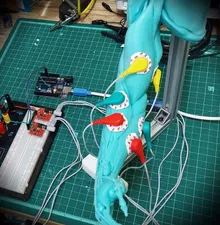
My thesis, "Soft robotics based prosthetics and other mobility assistance robots," developed a PVDF-HFP and polyaniline-based ionic electroactive polymer (EAP) actuator, paired with an LSTM-based control system driven by real-time EMG sensor data — a step toward low-cost, responsive prosthetic control. It was guided by Dr. Himansu S. Biswal (School of Chemical Sciences, NISER) and Dr. Subhankar Mishra (School of Computer Sciences, NISER).

Demo: the ionic EAP actuator in action